
A practical, human approach for international professionals
For many international professionals, the idea of giving a presentation in English fills them with dread. Yet, so many recognise that developing their public speaking skills can boost their career opportunities like nothing else.
In our work at Intrepid English, we see this again and again. The fear is rarely rooted in a lack of English skills; more often, it is about how people prepare, how they structure their message and how they support themselves before they speak. Clear, confident presentations are not about being ‘perfect’. They are about helping your audience understand your message, one idea at a time.
In this podcast, we will look at a practical process to help you prepare without over-preparing, design simple and effective slides, practise your delivery with clarity and arrive at your presentation feeling calm and focused.
Why clarity matters more than confidence
You know your topic well, you’ve prepared carefully. And yet, when you stand up to speak, your mind goes blank, your mouth goes dry, your voice feels tense or your message becomes unclear.
Many people say they want to sound “confident” when they present. They feel the nerves, but ‘grin and bear it’ and force their way through. But confidence is not something you can force. Confidence comes after consistently overcoming challenges, proving to yourself that you can do it. It comes from learning to work with your body and nervous system to try, improve and try again.
When you know what you want to say, you know why it matters to your audience and you have practised, you’ll feel more prepared. Delivering your message with someone who will give you honest, actionable feedback will also help, as well as learning some simple techniques to calm your nerves before you perform. You’ll notice your voice becomes steadier, your message becomes easier to follow, your audience will relate to you more deeply. This is why preparation is the foundation of confident delivery.
Step 1: Prepare your message, not a script
One of the most common mistakes we see is over-preparation. Learners often write full sentences for their presentation. They try to memorise long explanations and control every word. However, that approach makes the presentation sound scripted or unnatural. It’s also very time-consuming to memorise full paragraphs of text. If one sentence is forgotten, panic appears and you focus on remembering words instead of connecting with the audience. Instead of preparing a script, prepare your message in the form of bullet points.
Before you even open PowerPoint or Canva presentation, take a piece of paper and answer these questions:
- What is the one main idea I want my audience to take away from this presentation?
- What are the three key points that support this idea?
- What do I want my audience to think, feel, or do after my presentation?
These questions help you move from “What will I say?” to “What do I want them to understand?”
Step 2: Keep your slides simple and supportive
Your slides are not your presentation; they are visual support for your message (that you say). When slides contain too much text, your audience starts reading instead of listening. The brain cannot read and listen deeply at the same time. Attention becomes divided and your message loses impact. Have you ever tried to read something while someone was talking to you? It’s not effective. This increases the effort that the audience has to put into understanding your presentation – and you want to make it as easy as possible for them to understand your message.
Clear rules for effective slides
Here are simple rules we recommend to members of the Global Communicators Hub:
- One idea per slide
- Minimal text (keywords only, not sentences)
- Large, easy-to-read font
- Strong visual anchors such as icons, diagrams or images
- Consistent layout and colours
If you need to explain something complex, do it with your voice, not with text on the slide.
A simple slide checklist
After you’ve prepared your presentation slides, check each slide and ask:
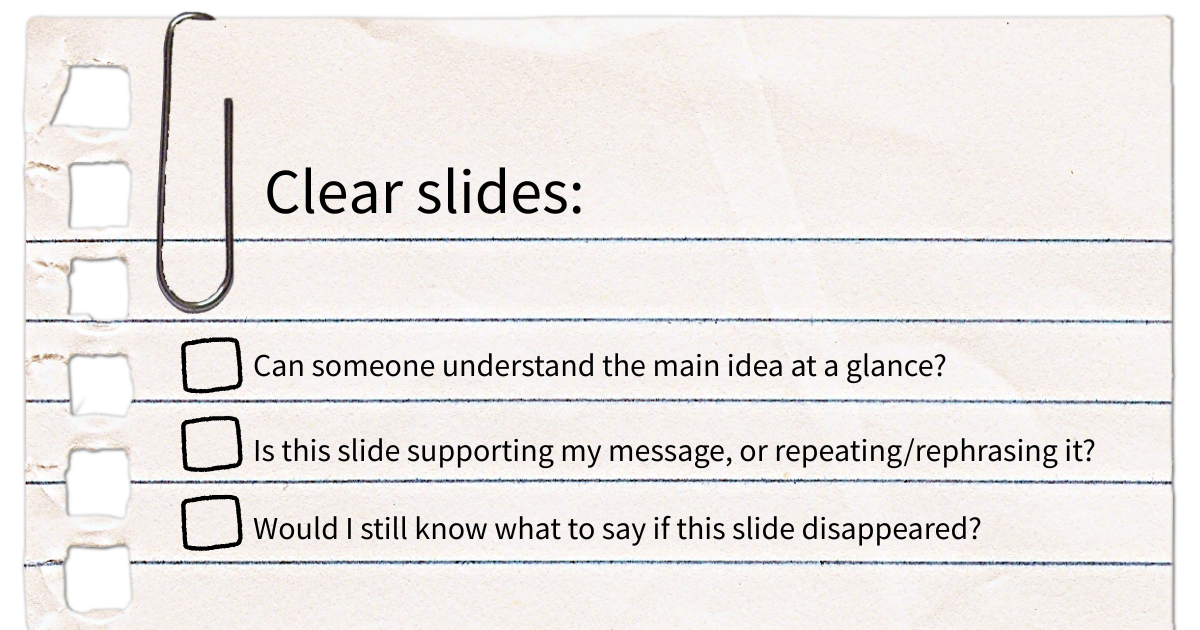
If the answer to the last question is “no”, the slide is doing too much work.
Step 3: Practise for clarity, not perfection
Practising a presentation does not mean repeating it again and again until it is ‘perfect’. That often increases stress, because aiming for perfection over expression only increases the pressure you put on yourself. Instead, practise for clarity.
Try this three-step practice process
- Speak without your slides
Explain your topic out loud using only your key points. This helps you focus on meaning, not memory. - Explain it to a non-expert
If a colleague or friend can understand you easily, your message is clear enough. Having a safe space to practice without fear of being judged is also a game-changer. - Time your key sections
Know roughly how long each part should take. This helps you stay calm and flexible.
Try to not to focus on presenting everything ‘perfectly’; perfection doesn’t exist. Your goal is to help the audience to follow your thinking and leave with one clear takeaway.
Step 4: Create your own pre-presentation process
Many professionals experience physical signs of stress before presenting: Fast breathing, tense shoulders, blank mind, dry mouth, tight throat. These symptoms are perfectly normal; your body is preparing for something important. Adrenaline is rushing through your body. Instead of fighting these feelings, it helps to follow a simple pre-presentation process that rebalances your nervous system.
My practical pre-presentation process
Here’s a practical pre-presentation process that I use. Once I’ve thoroughly prepared, I use this 5–10 minutes before I speak to calm my nervous system and ensure I present powerfully. Try this and let me know if it helps.
1. Find a private space
If you are in a private space, take one or two minutes to gently stretch your body.
- Stand tall with your feet hip-width apart
- Roll your shoulders back
- Open your arms wide or place your hands on your hips
- Lift your chest and lengthen your spine
Research by social psychologist Amy Cuddy suggests that open, expansive postures like this can help your body feel more confident and capable. Even a short moment of standing tall can send a signal of safety and strength to your nervous system.
Of course, this step is optional, but many of my learners find this very effective.
3. Slow your breathing
I love this ‘box breathing’ exercise to calm my nerves.
- Breathe in through your nose for four counts. Hold for two.
- Breathe out slowly through your mouth for six counts. Hold for two.
- Repeat that for one or two minutes.
If your heart is racing, this really helps to calm it down.
3. Clarify your intention
I like to remind myself: “I am here to share one clear message. I do not need to impress anyone, because my goal is to help people understand.” This process really helps your body to feel safer, and it’s particularly helpful for international professionals because it makes it easier to access the English you have learned and practised.
A reflection from our work with our learners
Over the last 15 years, we’ve noticed a pattern: highly capable professionals often try to “sound advanced” instead of speaking clearly. They use very complex vocabulary, they add extra information and over-explain their points, sometimes more than once. Unfortunately, this often has the opposite effect. The message becomes harder to follow and the speaker feels more pressure.
Remember, clear communication is not about showing how much you know or impressing people with your advanced vocabulary, it’s about choosing what matters most and saying it in a way that allows your message to land.
Bringing it all together
Clear, confident presentations are built through a process:
- Prepare your message, not a script
- Design slides that support what you will say, not distract the audience
- Practise for clarity and flow
- Take a couple of minutes to become calm, grounded and focused before you present
When you follow this approach, confidence becomes a result, not a goal.
Inside the Global Communicators Hub
Inside the Global Communicators Hub, we go much deeper using our CLARITY™ framework. We help international professionals develop calm, clear and authentic communication skills that work in real workplace situations, including presentations, meetings and leadership conversations.
This podcast reflects the kind of thinking and practice we develop together inside the Hub. If you would like to explore communication beyond grammar and vocabulary, and learn how to express yourself with clarity and confidence at work, you are very welcome to join us.
It’s an inclusive community of international professionals like you who are focused on learning the skills to overcome the communication barriers that have been holding you back.
We hope to see you soon inside the Hub.